Low Pressure Casting Services
Meco fills steel dies from below with controlled gas pressure to cast A356 and ZL101 aluminum at ISO 8062 CT7 to CT9, on runs of 500 to 50,000 parts a year.

What Is Low Pressure Casting?
Low pressure casting, also called low pressure die casting or LPDC, uses gas pressure to push molten aluminum up a riser tube and into a steel die from below. The fill is slow and non-turbulent, so less gas is trapped and the casting solidifies dense from the top down.
That fill behaviour is why the process suits pressure-tight and safety-critical parts. Meco holds ISO 8062 CT7 to CT9 as cast, quotes 4 to 12 week production lead times, and treats 500 to 50,000 parts a year as the economic window. Below that window, gravity casting is usually cheaper. Above it, die casting services win on cycle time. All five processes sit under our custom casting hub.
Why Choose Meco for Low Pressure Casting
Dense, dimensionally stable aluminum castings, machined, treated and finished under one roof.
Low Porosity Castings
Non-turbulent filling and directional solidification give a dense grain structure, so parts hold pressure and resist fatigue loading.
Certified Quality System
Every casting cell runs under IATF 16949:2016, which incorporates all ISO 9001:2015 requirements. PPAP, FAI and full lot traceability are standard.
Safety-Critical Parts
The process is built for wheels, suspension arms, manifolds and housings that must stay leak free under load and thermal cycling.
Turnkey After Casting
In-house CNC machining, heat treatment and surface finishing mean one supplier, one PO, one point of accountability.
Verified Integrity
X-ray, ultrasonic and dye penetrant inspection confirm internal soundness. CMM measurement resolves to 0.002 mm, with EN 10204 3.1 certificates on request.
DFM Before Tooling
Every quote comes back with DFM notes inside 24 hours. Design changes agreed before the die is cut typically remove 15 to 30 percent of part cost.
Low Pressure Casting Capabilities
What the process holds, what it costs to tool, and how far it scales.
Fill speed and pressure are held under closed-loop control, so the casting solidifies directionally into the feed path. Shrinkage porosity is designed out rather than machined around, which is what makes the parts suitable for hydraulic and pneumatic duty.
- Pressure-tight castings
- Dense, uniform grain structure
Steel dies plus a controlled fill hold ISO 8062 CT7 to CT9 as cast. Critical features are finished on our own CNC cells to ISO 2768 and 0.01 mm where the drawing calls for it, so most parts skip an outside machining supplier entirely.
- Near-net shape as cast
- Machining kept to key features
There is no minimum order quantity. Tooling runs 4 to 14 weeks, production 4 to 12 weeks, and the process is at its most economical between 500 and 50,000 parts a year. Casting runs from 20,000 m2 in Thailand and 16,000 m2 in China, with warehousing in North America and Asia.
- No MOQ, 500 to 50,000 per year
- Dual-country production
Low Pressure Casting Alloys and Specifications
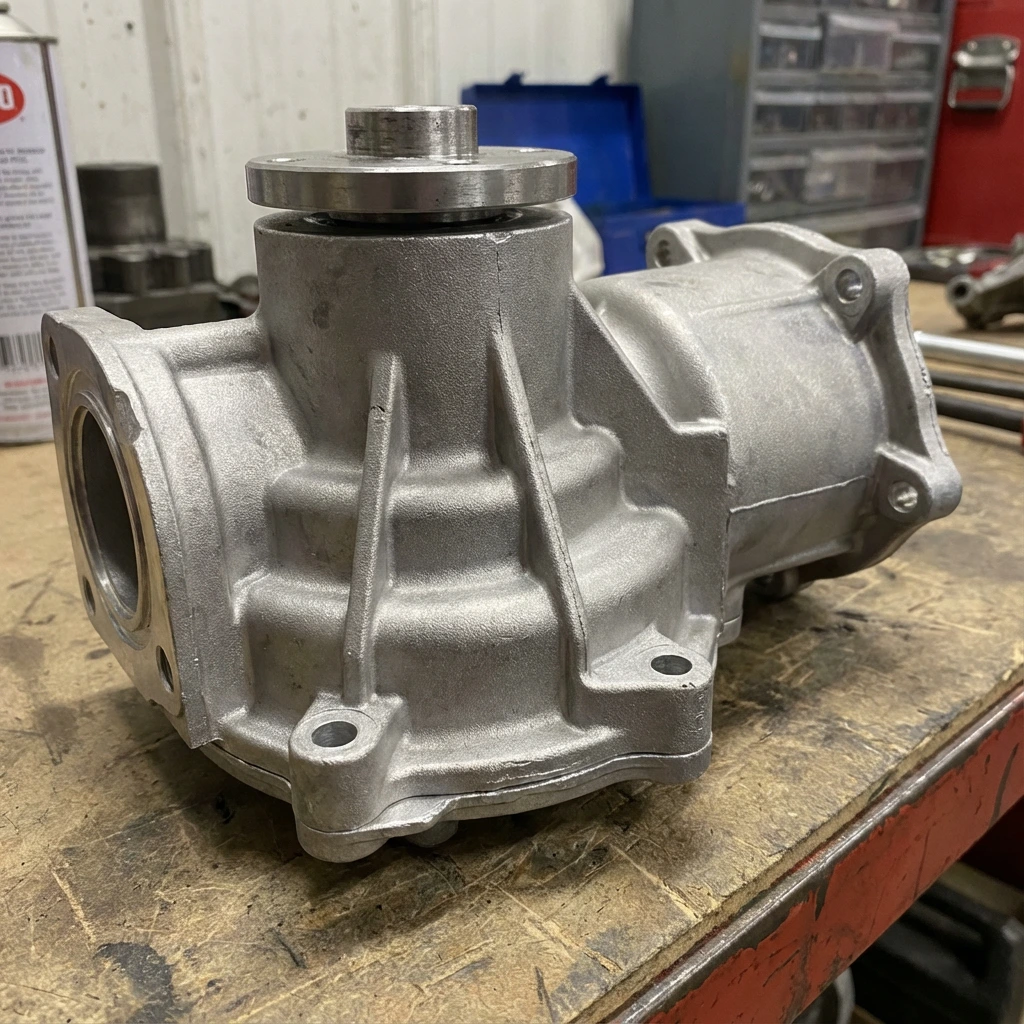
Meco casts the Al-Si-Mg family in low pressure tooling, then heat treats, machines and finishes in house.
Alloy choice drives everything downstream: temper response, machinability and how tight a tolerance the die can hold. Both grades below take T5 and T6 tempers, and both are supplied with EN 10204 3.1 material certificates on request. Certificates are explained in our EN 10204 3.1 guide.
Alloys and Specifications
| Alloy | Tempers | Why it is used | Typical low pressure parts |
|---|---|---|---|
| A356 | F, T5, T6 | Strong after heat treatment, ductile, pressure tight, corrosion resistant, welds well | Wheels, suspension arms, pump and valve bodies, hydraulic manifolds |
| ZL101 | F, T5, T6 | Chinese Al-Si-Mg grade in the A356 family, good castability into thin ribs | Structural housings, lighting bodies, mounting brackets, enclosures |
| Standards | Applied throughout | ASTM B179 ingot and molten metal, GB/T 6414 general specifications | ISO 8062-3, ISO 286 and ANSI B4.1 for dimensional tolerance, ICI for linear tolerance |
Scroll inside the table to see all rows and columns
Low Pressure Casting Tolerances and Process Data
| Parameter | Low pressure casting | Notes |
|---|---|---|
| As-cast tolerance | ISO 8062 CT7 to CT9 | Grade depends on part size, wall section and core count |
| Machined features | 0.01 mm, ISO 2768 | Cut on our own CNC machining cells |
| Inspection | CMM to 0.002 mm | Plus X-ray, ultrasonic and dye penetrant NDT |
| Ideal volume | 500 to 50,000 parts per year | No MOQ. Prototypes and pilot runs supported |
| Production lead time | 4 to 12 weeks | From approved tooling and released PO |
| Tooling lead time | 4 to 14 weeks | Steel die, with a T0 and T1 plan agreed upfront |
| Heat treatment | T5 and T6 | In-house metal heat treatment |
| Finishing | Anodize, powder coat, blast, paint | See surface finishing services |
| Documentation | PPAP, FAI, CoA, EN 10204 3.1 | Full lot and serial traceability under IATF 16949:2016 |
Scroll inside the table to see all rows and columns
Working out what a casting will cost before tooling is committed? Our metal part pricing guide breaks the numbers down by process.
Industries Served by Low Pressure Casting
Low pressure casting is specified where a part has to stay dense, dimensionally stable and leak free under load. These are the sectors Meco casts for most often.
Aerospace Parts Manufacturing
Low pressure aluminum castings give a high strength-to-weight ratio with minimal porosity. Meco supplies housings, structural brackets and control components with FAIR and PPAP documentation, X-ray and dye penetrant NDT, and serial traceability.
Learn more about aerospaceAutomotive Parts Manufacturing
The classic low pressure application: wheels, suspension arms and cylinder blocks where uniform density and fatigue life matter more than cycle time. Production runs under IATF 16949:2016 with PPAP submission as standard.
Learn more about automotiveHeavy Equipment Manufacturing
Pressure-tight, high-load castings for hydraulic manifolds, housings and support structures. Dense sections handle mechanical and thermal stress without weeping at the wall.
Learn more about heavy equipmentHome Appliances Manufacturing
Pressure cooker bases, heating platens and structural frames. Aluminum brings thermal conductivity and corrosion resistance, and the as-cast finish takes coating with little preparation.
Learn more about appliancesIndustrial Manufacturing
Leak-free castings for pumps, valves, compressors and impellers. Cored passages come out clean, so fluid-handling parts hold pressure straight off the machining cell.
Learn more about industrialLight Manufacturing
Outdoor luminaire bodies and heat-sink housings in one casting. Fine, ribbed sections fill reliably, which keeps thermal performance high without a bolted-on sink.
Learn more about lightingMedical Equipment Manufacturing
Large diagnostic housings, C-arm sections and support frames where rigidity and dimensional stability matter. Castings are supplied with full lot traceability and material certificates.
Learn more about medicalTelecommunications Manufacturing
Sealed, corrosion-resistant enclosures and base plates for outdoor network hardware. The dense wall section conducts heat away from radio electronics and keeps the gasket face flat.
Learn more about telecomOffice Furniture Manufacturer
Chair bases, column feet and table legs in heat-treatable aluminum. T6 gives the load rating, and the smooth as-cast skin polishes or anodizes for visible surfaces.
Learn more about furnitureCustom Electronics Manufacturing
Cast heat sinks and industrial enclosures, then populated and boxed through our PCB design and assembly line. Aluminum shields the electronics and moves the heat out.
Learn more about electronicsLow Pressure Casting vs Other Casting Methods
Where low pressure casting beats gravity and high pressure die casting on integrity, tooling cost and volume, using Meco's own process reference figures.
| Feature | Low pressure casting | Gravity casting | High pressure die casting |
|---|---|---|---|
| Typical tolerance | ISO 8062 CT7 to CT9 | ISO 8062 CT7 to CT8 | NADCA standard 0.010 in |
| Ideal volume | 500 to 50,000 per year | 500 to 50,000 per year | 5,000 to 1,000,000+ |
| Lead time | 4 to 12 weeks | 4 to 10 weeks | 6 to 14 weeks |
| Mechanical properties | Excellent dense, low porosity, heat treatable | Good low porosity, heat treatable | Fair trapped gas limits heat treatment |
| Tooling cost | Moderate steel die, quoted per part | Low to moderate gravity dies 10,000 to 30,000 USD | High dies 20,000 to 150,000+ USD |
| Metal yield | High riser tube returns unused metal | Moderate large risers needed | Moderate runners and overflows |
| Part complexity | Good sand or steel cores allowed | Good sand cores allowed | Excellent thin walls, no sand cores |
| Best application | Pressure-tight, safety-critical wheels, suspension, manifolds | General structural parts | Thin-wall housings at volume |
Scroll inside the table to see all rows and columns
Below roughly 500 parts a year, look at gravity casting or sand casting first. Above 5,000 thin-wall parts a year, die casting services usually win on unit cost. For a plain-English walkthrough of the pouring methods, read what is gravity casting, and for tolerance grades see casting tolerances explained.
Low Pressure Casting FAQ
What is low pressure casting used for?
Low pressure casting is used for aluminum parts that must be dense and pressure tight, such as wheels, suspension arms, pump and valve bodies and hydraulic manifolds. Gas pressure fills the die slowly from below, so less air is entrained and the casting feeds properly as it solidifies. Meco holds ISO 8062 CT7 to CT9 as cast on this process.
What aluminum alloys can be low pressure cast?
Meco runs A356 and ZL101, both Al-Si-Mg grades, in F, T5 and T6 conditions. A356 is the default for load-bearing and pressure-tight parts because it heat treats predictably and stays ductile. Our engineers will confirm the grade against your loads, corrosion environment and finish before tooling is cut.
What tolerances can low pressure casting hold?
ISO 8062 CT7 to CT9 as cast, depending on part size, wall section and core count. Features that need more than that are machined in house to ISO 2768 and 0.01 mm, and verified on a CMM resolving to 0.002 mm. Nominate the critical features on your drawing and we will tell you at DFM stage which ones need machining.
Low pressure casting or gravity casting: which should I use?
Both suit 500 to 50,000 parts a year, so the decision is usually about integrity rather than volume. Choose low pressure casting when the part must hold pressure, carry fatigue loading, or come out of the die with less machining stock. Choose gravity casting when the part is simpler, the tooling budget is tighter, or you want a slightly shorter 4 to 10 week lead time.
Can low pressure cast parts be heat treated?
Yes. Low porosity is exactly what makes heat treatment reliable, because trapped gas blisters at solution temperature. T5 and T6 tempers are both standard, run on our own metal heat treatment lines, which is the main mechanical advantage over high pressure die casting.
What are the key design rules for a low pressure casting?
Keep wall thickness consistent, allow 2 to 3 degrees of draft, and use generous radii instead of sharp internal corners. Sections should thicken towards the gate so the part feeds from the riser tube as it freezes. Gate position is set during our DFM review, not after the die is cut.
What drives low pressure casting cost and lead time?
Tooling complexity, alloy, part weight, annual volume and post-processing. Steel tooling takes 4 to 14 weeks and production runs 4 to 12 weeks once tooling is approved. DFM changes agreed before tooling typically take 15 to 30 percent out of part cost, so send drawings early. There is no minimum order quantity.
How to Get Started
Send a STEP or IGES file with alloy, annual volume, tolerances and finish. Send it to our engineers and you get a response inside 24 hours.
You receive a cost breakdown plus DFM notes on wall sections, draft and gating, with tooling and sample timing.
We cut the steel die on a 4 to 14 week schedule and deliver T1 samples with dimensional and NDT reports.
After PPAP approval we run production, machining, heat treatment and finishing, then ship from warehousing in North America or Asia.
Low Pressure Casting Resources

What Is Gravity Casting?
The closest alternative to low pressure casting. Permanent mould filling, T6 response, tooling cost, and where each process wins.
Read the guide →
Casting Tolerances Explained
How ISO 8062 CT grades and NADCA standards actually work, so you know which features to nominate for machining.
Read the guide →
What Does a Metal Part Cost?
Tooling, alloy, volume and post-processing broken down by process, with the numbers behind a casting quote.
Read the guide →Swipe for all three guides
