Custom Metal Forging Services
We forge steel, stainless, aluminum, brass, and copper parts that carry load without failing. Hot and cold forging, then machining, heat treatment, and finishing under one roof.

What Are Custom Metal Forging Services?
Forging shapes solid metal under compressive force instead of cutting or melting it. The grain flows around the part shape rather than being severed, so a forged part is stronger in fatigue and impact than a machined or cast equivalent of the same alloy.
Meco runs hot forging and cold forging alongside in-house CNC machining, heat treatment, and surface finishing. A forged part can leave finished and inspected on one purchase order.
See the full process list on our capabilities page.
Processes
2 Methods
Hot forging and cold forging, both in house.
Metals
6 Families
Carbon steel, alloy steel, stainless, aluminum, brass, copper.
Tolerance
Class F
BS EN 10243-1 fine class, then 0.01 mm where machined.
Quality
IATF 16949:2016
The standard automotive OEMs require, applied to every industry.
Hot Forging and Cold Forging
Temperature decides which route fits. Hot forging buys shape complexity, cold forging buys surface finish and dimensional accuracy.
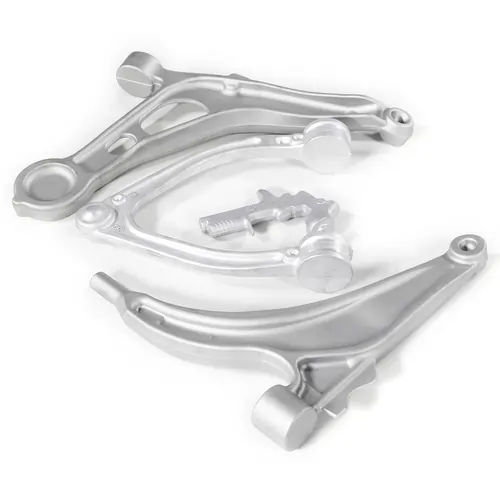
Hot Forging
The billet is heated above its recrystallisation point, so it flows into deep cavities and thin ribs with far less press force. Best for axles, shafts, yokes, gear blanks, and structural arms.
- Temperature650 to 1300 C
- ToleranceBS EN 10243-1 Class F
- StandardsIATF 16949, GB/T 8545
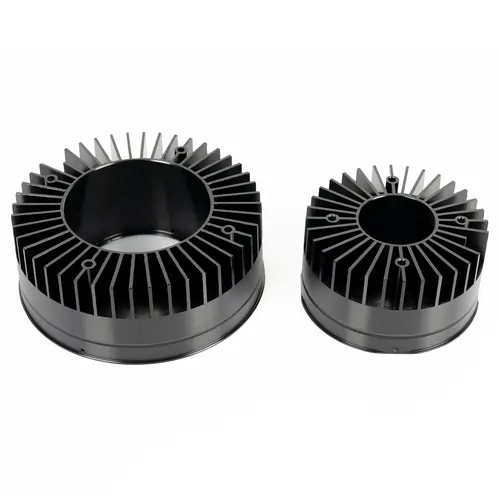
Cold Forging
Forming at or near room temperature work hardens the metal and leaves a bright surface that often needs no machining. Best for fasteners, pins, bushings, sockets, and small gears in large volumes.
- TemperatureAmbient to 200 C
- Tolerance0.05 to 0.2 mm typical
- StandardsIATF 16949:2016
Swipe to see both methods
Metals We Forge
Six families, the grades we run routinely, and what happens after the press. Full options are on our surface finishing page.
| Metal | Common Grades | Heat Treatment | Typical Parts |
|---|---|---|---|
| Carbon Steel | 1045, 1035, 1020 | Normalise, quench and temper | Shafts, pins, levers |
| Alloy Steel | 4140, 4340, 42CrMo | Quench and temper | Knuckles, arms, gear blanks |
| Stainless Steel | 304, 316, 17-4PH | Solution anneal, age harden | Valve bodies, flanges, fittings |
| Aluminum | 6061, 6082, 7075, 2024 | T6 solution and age | Structural fittings, brackets |
| Brass | C360, C377, C464 | Stress relieve | Plumbing fittings, valve stems |
| Copper | C110, C101 | Anneal | Terminals, connectors, busbar lugs |
Swipe the table to see every column
Which Forging Method Fits Your Part?
Choose on three inputs: part size, annual volume, and the tightest tolerance the part genuinely needs. If you are still choosing a supplier, read how to find a manufacturer for your product.
| Method | Weight Range | Best Volume | Typical Tolerance | Best For |
|---|---|---|---|---|
| Closed die, hot | 0.1 to 50 kg | 1,000 plus | Class F, 0.6 to 1.3 mm | Repeatable near net shapes |
| Open die, hot | 5 kg and up | 1 to 500 | 3 to 6 mm, machined after | Large simple blanks, no tooling |
| Cold forging | 0.01 to 5 kg | 50,000 plus | 0.05 to 0.2 mm | Lowest unit cost, bright finish |
| CNC machining | Any | 1 to 5,000 | 0.01 mm | No tooling, tightest features |
Swipe the table sideways to see every column
When Forging Is Not the Right Choice
Forging needs a die and a press. Three cases where another process wins, and we will say so on the quote.

Under 200 Pieces
A die has to be paid for before the first part exists. Below roughly 200 pieces it rarely amortises, and machining holds 0.01 mm with no tooling wait.
See CNC machining →
Thin Walls or Internal Cavities
Forged metal cannot flow into thin walls or enclosed voids. Housings, covers, and cored bodies belong in die casting.
See die casting →
Flat Sheet Parts to 6 mm
If the part starts as flat sheet and stays thin, stamping is faster and cheaper per piece than forging a blank and machining it down.
See metal stamping →Swipe for all three alternatives
Published Forging Tolerances
Real numbers, not "tight tolerances". Steel drop forgings follow BS EN 10243-1. Aluminum and magnesium follow ASTM B247. Fine class is the tightest, coarse the loosest.
| Dimension (mm) | Class F, fine | Class C, coarse |
|---|---|---|
| Up to 50 | 0.6 | 1.2 |
| 50 to 120 | 0.8 | 1.6 |
| 120 to 200 | 1.0 | 2.0 |
| 200 to 300 | 1.3 | 2.6 |
Length, width, and height inside the die. Dimensions crossing the parting line follow the die closure table below, which runs wider on the plus side.
| Net Weight (kg) | Class F, die closure | Class C, die closure |
|---|---|---|
| Up to 0.5 | +0.6 / -0.3 | +0.9 / -0.4 |
| 0.5 to 1.5 | +0.9 / -0.4 | +1.3 / -0.6 |
| 1.5 to 3.0 | +1.1 / -0.5 | +1.6 / -0.8 |
| 3.0 to 6.0 | +1.4 / -0.7 | +2.0 / -1.0 |
Swipe the tables sideways on mobile to see every column.
| Net Weight (kg) | Plus (+ mm) | Minus (- mm) |
|---|---|---|
| Up to 0.5 | 0.80 | 0.40 |
| 0.5 to 2.0 | 1.00 | 0.50 |
| 2.0 to 5.0 | 1.50 | 0.80 |
| 5.0 to 10.0 | 2.00 | 1.00 |
Die closure, meaning dimensions measured across the parting line. Values are typical for standard grade.
| Length (mm) | Straightness (mm) | Net Weight (kg) | Max Mismatch (mm) |
|---|---|---|---|
| 0 to 250 | 0.80 | Up to 1.0 | 0.50 |
| 250 to 500 | 1.50 | 1.0 to 3.0 | 0.80 |
| 500 to 1000 | 2.50 | 3.0 to 10.0 | 1.00 |
| Over 1000 | 4.00 | 10.0 to 20.0 | 1.50 |
Mismatch is misalignment between the upper and lower die halves. Where a feature must hold tighter than any figure above, we forge the blank and finish that one feature on CNC machining to 0.01 mm. Material certificates to EN 10204 3.1 are available on request.
6 Design Rules That Cut Forging Cost
Each one is a change our engineers ask for most often on incoming drawings.
Add Draft to Every Vertical Wall
Use 3 to 7 degrees on steel. Without draft the part grips the die and needs force to eject.
Use Generous Fillets
Sharp internal corners stop metal flow and crack dies. Larger radii fill better and last longer.
Put the Parting Line on One Plane
A flat, single plane split is the cheapest die to cut and the easiest to trim.
Watch Rib Height Against Web
Tall thin ribs on a thin web need extra press force and may not fill. Thicken the web or shorten the rib.
Add Machining Allowance Only Where Needed
Allowance on every face is metal you pay for twice. Mark only the faces that get cut.
Send the Drawing Before You Freeze It
DFM changes made while the design can still move typically remove 15 to 30 percent from the part price.
Swipe through all six rules
What Drives the Price of a Forged Part?
A Note on Die Prices You See Quoted Online
Published forging die prices vary widely across the industry because they describe very different parts, so we do not quote tooling from a table. Send the drawing and you get an itemised tooling and piece price, with the DFM notes behind it, inside 24 hours. Tooling ownership and amortisation terms are confirmed in writing on that quote.
Forged Parts by Industry
Where forged strength earns its cost.
Swipe the tabs to see all five industries
Automotive Forged Components
Steering knuckles, control arms, yokes, hubs, gear blanks, and CV joint components. Programs run under APQP with PPAP submission, SPC on control characteristics, and full lot traceability.
Heavy Equipment Forgings
Track links, pins and bushings, lift arms, bucket teeth, and hydraulic cylinder ends. Forged grain flow is what keeps these parts alive under shock loading.
Aerospace and Defense Forgings
Structural fittings, brackets, and landing gear components in aluminum and titanium. We supply material certificates, FAIR, CMM reports, and NDT. Meco is not certified to AS9100 or ITAR, and we say so up front.
Industrial and Energy Forgings
Valve bodies, flanges, pump shafts, couplings, and gearbox blanks. Pressure and wear parts where a casting porosity risk is not acceptable.
Appliance and Hardware Forgings
Hinge pins, spindles, brass fittings, valve stems, and cold forged fasteners. High volume cold forging keeps unit cost down and surface finish good enough to plate directly.
Why Buyers Forge With Meco
Four things you can check before you send a drawing.
No Minimum Order
10 pieces to 10 million on the same line. Low volumes run without forging tooling where that is cheaper for you.
Published Tolerances
The tables on this page are the numbers we quote against, taken from BS EN 10243-1 and ASTM B247.
Two Countries, Both Ours
20,000 m² in Thailand and 16,000 m² in China, owned and operated, not brokered.
Swipe for all four
Custom Metal Forging FAQ
What is custom metal forging?
Custom metal forging shapes solid metal under compressive force, either hot above the recrystallisation point or cold at close to room temperature. The metal grain flows around the part shape instead of being cut through, which is why forged parts outperform machined and cast equivalents in fatigue and impact. Meco forges to customer drawings rather than from a catalogue, then machines, heat treats, and finishes in the same plants.
How accurate are forged parts?
Steel drop forgings hold BS EN 10243-1 Class F, which is 0.6 mm up to 50 mm nominal and 1.3 mm at 200 to 300 mm. Aluminum and magnesium follow ASTM B247, with die closure from 0.80 mm plus on small parts. Cold forged parts run tighter, typically 0.05 to 0.2 mm. Where a bore or mating face has to hold tighter, we forge the blank and finish that feature with CNC machining to 0.01 mm.
What is the difference between hot forging and cold forging?
Hot forging heats the billet to 650 to 1300 C, so the metal flows easily and fills complex cavities with less press force. Cold forging works at ambient up to about 200 C, which work hardens the metal and leaves a bright, accurate surface but limits shape complexity. Hot forging wins on geometry, cold forging wins on finish, accuracy, and unit cost at high volume.
How much does forging tooling cost and how long does it take?
Forging die lead time is 6 to 12 weeks depending on complexity and the number of impressions. Published die prices vary widely across the industry because they describe very different parts, so we do not quote tooling from a table. Send a drawing and you get an itemised tooling and piece price with the DFM notes behind it inside 24 hours. Tooling ownership and amortisation terms are confirmed in writing on that quote.
Is there a minimum order quantity for forging?
Meco has no minimum order quantity. In practice, quantities under roughly 200 pieces are usually cheaper machined from billet than forged, because the die has to be paid for before the first part exists. We will tell you which route is cheaper on the quote rather than pushing the tooling.
Is forging stronger than casting or machining?
For the same alloy, yes, in fatigue and impact. Forging refines the grain and aligns its flow with the part contour, and there is no solidification porosity as there can be in a casting. Machining severs the grain wherever it cuts across it. That is why load bearing parts such as knuckles, track links, and gear blanks are forged rather than cast.
Can you heat treat and machine the forgings too?
Yes, and it is the main reason buyers consolidate here. Heat treatment, CNC machining, surface finishing, and mechanical assembly all run under one IATF 16949:2016 system. You get a finished, inspected part on one purchase order instead of managing four suppliers and the freight between them.
Who protects my design if I share it?
Your design stays yours. Meco provides IP protection and signs NDAs as standard before any drawing review begins, which matters most for brand owners sending a full product rather than a single part. Tooling ownership terms are set out in writing on the quote, so there is nothing to discover later.
How to Start a Forging Project
STEP or IGES plus a 2D drawing. Tell us the alloy, net weight, tolerance class, and annual volume. Use our quote form. You get a response inside 24 hours.
We check draft, fillets, parting line, and allowance. This is where the 15 to 30 percent saving comes from, and it only works before the design is frozen.
Die in 6 to 12 weeks, first off parts inspected on CMM, and a first article report for your approval.
Learn More About Forging and Manufacturing
Three guides that go deeper into the decisions this page touches on.

Metal Part Cost Guide
What a metal part actually costs to make, broken down by process, material, tolerance, and volume.
Read the guide →
How to Find a Manufacturer
What to ask a supplier before you send tooling money, and the answers that should worry you.
Read the guide →
EN 10204 3.1 Certification
What a 3.1 material certificate covers, who signs it, and when your buyer will ask for one.
Read the guide →Swipe for all three guides
