CNC Tapping Services for Precision Threaded Holes
IATF 16949:2016 certified CNC tapping for metals and plastics, with consistent threads from prototype through high volume production.

What Is CNC Tapping?
CNC tapping is a machining process that cuts internal threads inside a pre-drilled hole. A rotating tool called a tap feeds into the hole at a controlled speed and depth, creating threads that accept screws or bolts. The machine synchronizes spindle rotation with feed, so thread position stays within plus or minus 0.05 mm on every part.
Meco runs tapping as part of custom CNC machining, combined with CNC drilling, milling, and turning in one setup where the part allows. That removes re-fixturing, shortens lead time, and prevents alignment error between operations. All work runs under our IATF 16949:2016 quality system with full traceability.
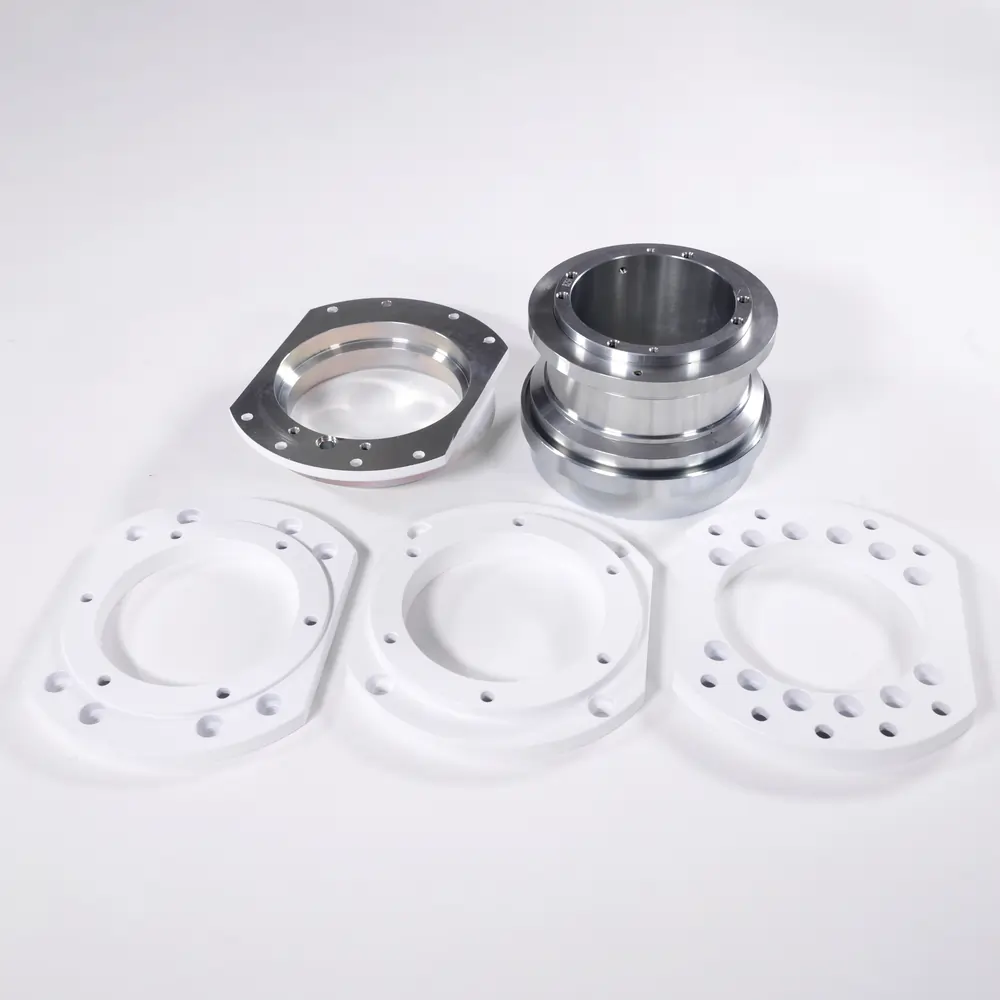
Why CNC Tapping for Threaded Components
CNC tapping is the fastest repeatable way to cut internal threads on production parts, because the machine removes operator variability. Part 1 and part 10,000 share the same thread geometry. It is the standard threading method for automotive, aerospace, and medical device assemblies.
Why Choose Meco for CNC Tapping
Accurate threads, one accountable supplier, lower total cost.
Thread Level Precision
Thread position to plus or minus 0.05 mm. Class 6H and 2B threads verified by gauge. CMM verification to plus or minus 0.002 mm on request.
Vertically Integrated
Machining, casting, forging, finishing, and assembly in house across 40+ processes. One PO, one quality system, shorter lead times.
Material Expertise
Aluminum, stainless, carbon steel, brass, copper, plus nylon, acetal, and polycarbonate. Tap geometry matched to material for tool life.
DFM Before Cutting
Engineers review hole size, thread callout, and edge distance before production. DFM changes typically cut 15 to 30% of part cost.
Our CNC Tapping Capabilities
Three tapping methods, selected by hole type, material, and thread class.
Rigid Tapping
Spindle rotation and feed are synchronized and the tap is held with no float. This gives the tightest thread control and the cleanest thread form.
- Exact feed synchronization
- Best for through holes
Floating Tapping
A self adjusting holder absorbs small feed mismatches between spindle and tap. That protects the tap and extends tool life in blind holes and harder alloys.
- Absorbs feed variation
- Longer tap life in hard material
Vertical and Horizontal Tapping
We tap on both vertical and horizontal setups, so parts needing threads on more than one face are finished without a separate operation.
- Multi axis compatibility
- Small and large part support
CNC Tapping Materials and Specifications
We tap every metal family and core engineering resin we run in house, with tap geometry and coating selected per material. For grade level data across all our processes, see the manufacturing materials hub and the CNC machining materials guide.
Metals We Tap
| Metal | Grades We Run | Tapping Notes |
|---|---|---|
| Aluminum | 6061, 7075, 5052, 2024 | Fast cycles, spiral flute taps clear soft chips cleanly |
| Stainless Steel | 303, 304, 316, 17-4PH | Coated taps and reduced speed to control work hardening |
| Carbon Steel | 1045, 4140, 4340 | Through coolant and peck cycles on deep holes |
| Brass | C360, C464 | Free machining, straight flute taps suit through holes |
| Copper | C110, C145 | Ductile, needs sharp geometry to avoid tearing the thread |
Scroll inside the table to see all columns
Plastics We Tap
| Resin | Chosen For | Tapping Notes |
|---|---|---|
| PA (Nylon) | Toughness and wear resistance | Absorbs moisture, so thread fit moves with humidity |
| POM (Acetal) | Low friction, dimensional stability | Holds thread form well, chips clear easily |
| PC (Polycarbonate) | Impact resistance and clarity | Notch sensitive, needs generous edge distance |
Scroll inside the table to see all columns
Thread Classes We Produce
| Class | Standard | Typical Use |
|---|---|---|
| 6H | ISO metric internal | General purpose metric threads |
| 6G | ISO metric internal | Plated or coated threads needing clearance |
| 2B | Unified inch internal | General purpose UNC and UNF |
| 3B | Unified inch internal | Tight fit, close tolerance assemblies |
Scroll inside the table to see all columns
CNC Tapping Tolerances
Unless your drawing states otherwise, we machine to ISO 2768 medium and hold thread position to plus or minus 0.05 mm.
ISO 2768 general tolerances
Linear dimensions, mm
| Class | 0.5 to 3 | 3 to 6 | 6 to 30 | 30 to 120 | 120 to 400 | 400 to 1000 | 1000 to 2000 |
|---|---|---|---|---|---|---|---|
| Fine (f) | 0.05 | 0.05 | 0.10 | 0.15 | 0.20 | 0.30 | 0.50 |
| Medium (m) | 0.10 | 0.10 | 0.20 | 0.30 | 0.50 | 0.80 | 1.20 |
| Coarse (c) | 0.20 | 0.30 | 0.50 | 0.80 | 1.20 | 2.00 | 3.00 |
| Very coarse (v) | n/a | 0.50 | 1.00 | 1.50 | 2.50 | 4.00 | 6.00 |
Scroll inside the table to see all columns
Angular dimensions
| Class | Up to 10 | 10 to 50 | 50 to 120 | 120 to 400 | Over 400 |
|---|---|---|---|---|---|
| Fine (f) | 1 deg | 0 deg 30 min | 0 deg 20 min | 0 deg 10 min | 0 deg 5 min |
| Medium (m) | 1 deg 30 min | 1 deg | 0 deg 30 min | 0 deg 15 min | 0 deg 10 min |
| Coarse (c) | 3 deg | 2 deg | 1 deg | 0 deg 30 min | 0 deg 20 min |
Scroll inside the table to see all columns
Broken edges, radius and chamfer
| Class | 0.5 to 3 | 3 to 6 | Over 6 |
|---|---|---|---|
| Fine (f) | 0.20 | 0.50 | 1.00 |
| Medium (m) | 0.40 | 1.00 | 2.00 |
ISO 286 fits
Hole basis and shaft basis
| System | Description |
|---|---|
| Hole basis | Hole size fixed (H), shaft varies. Preferred, because it suits standard tooling. |
| Shaft basis | Shaft size fixed (h), hole varies. Used with standard shafting. |
Common fit classes
| Fit | Type | Application |
|---|---|---|
| H7/g6 | Clearance | Precision sliding fit |
| H7/h6 | Transition to clearance | Accurate location |
| H7/p6 | Interference | Press fit, force required |
CNC Tapping vs Other Threading Methods
CNC tapping is fastest for standard hole sizes, thread milling is more flexible on large or hard to reach threads, and manual tapping suits one off repairs. Full breakdown in our guide to drilling vs tapping vs thread milling.
| Feature | CNC Tapping | Thread Milling | Manual Tapping |
|---|---|---|---|
| Precision | High | Very high | Low |
| Speed | Fast | Moderate | Slow |
| Best for | Production volume | Complex geometry | Prototypes and repairs |
| Cost efficiency | Excellent | Moderate | Low volume only |
| Tool life | Good | Excellent | Poor |
| Blind holes | With floating holder | Excellent | Difficult |
Scroll inside the table to see all columns
Need More Than Threading?
Move up to custom CNC machining for 3, 4, and 5 axis work, prototype through volume production, under one PO. Still choosing a grade? Start with our materials hub.
Where Our CNC Tapped Parts Are Used
Threaded components for structural, mechanical, and electronic assemblies across ten sectors, from first article to production volume.
Aerospace Parts Manufacturing
Threads in titanium, aluminum, and stainless components for aircraft structures, engine housings, and avionics enclosures. Every tapped feature is gauge verified and supported by FAIR, PPAP, material certificates, and serial traceability.
Automotive Parts Manufacturing
High speed tapping for drivetrain assemblies, transmission casings, and EV battery enclosures. Threads hold alignment under heat and vibration, so fasteners torque correctly across long production runs.
Medical and Healthcare
Threaded holes in surgical instruments, diagnostic equipment, and clinical housings. Tight thread control keeps assemblies secure and serviceable, with lot traceability and full inspection records on every shipment.
Heavy Equipment Manufacturing
Tapped joints and housings that carry high clamp loads in hydraulic systems, engine components, and machine frames. Deep hole tapping in alloy steel is run with peck cycles and through coolant to control chips.
Industrial Manufacturing
Threads in pump casings, manifolds, and automation housings for process equipment and fluid control. Accurate thread form and depth stop leaks at sealed ports and speed up line assembly.
Consumer Electronics
Small diameter threads for PCB standoffs, heat sink mounts, and device enclosures. Fine pitch taps and controlled depth keep threads clean in thin walls and shallow bosses.
Telecommunication
Tapped anchor points in aluminum and stainless enclosures for RF modules, antenna mounts, and network cabinets. Thread class is set to 6G where parts are plated, so coating thickness does not bind the fastener.
Commercial Furniture
Tapped connectors and brackets for ergonomic seating, shelving, and modular frame systems. Consistent threads keep joints tight through repeated adjustment and flat pack assembly in the field.
Home Appliances
Threaded holes for fastening motors, brackets, and panels in laundry, HVAC, and small appliance assemblies. Cycle times are tuned for high volume lines without giving up thread gauge results.
Lighting Manufacturing
Tapped mounting points in heat sinks, lamp housings, and reflector bodies for LED and architectural lighting. Threads are cut before anodizing or powder coating, then gauge checked after finishing.
Quality Assurance and Documentation
Every tapped part ships with traceability and inspection records. Our IATF 16949:2016 system covers receiving inspection, in process control, final thread verification, and packaging. IATF 16949 is built on all ISO 9001:2015 requirements.
Thread Gauging
Go/no-go and thread plug gauges confirm every tapped hole meets its 6H metric or 2B inch class callout.
First Article Inspection
FAI reports with full dimensional verification of first production parts against your drawing.
CMM Inspection
Coordinate measuring to plus or minus 0.002 mm, with GD&T evaluation and deviation reporting.
Full Traceability
Lot level tracking from raw material through tapping, finishing, and assembly, with material certificates on request.
CNC Tapping FAQ
What is CNC tapping?
CNC tapping cuts internal threads inside a pre-drilled hole using a rotating tool called a tap. The machine synchronizes spindle rotation with feed rate, which produces consistent threads that accept screws or bolts.
How does CNC tapping differ from thread milling?
Tapping forms the thread in one pass with a dedicated tap, so it is faster for standard sizes. Thread milling uses a cutter on a helical path, which suits large diameters, hard materials, and cases where a broken tool must not be trapped in the part.
What materials can be CNC tapped?
Aluminum, carbon steel, stainless steel, brass, copper, and plastics such as nylon, acetal, and polycarbonate. Tap geometry and coating are matched to the material to protect thread quality and tool life. Grade level data is in our CNC machining materials guide.
What accuracy can CNC tapping achieve?
Thread position is typically held within plus or minus 0.05 mm. Thread fit is set by class, usually 6H for metric or 2B for inch, and confirmed with gauges before shipment.
How is thread quality verified?
Go/no-go and thread plug gauges check every thread class requirement. Synchronized feed control and coolant prevent binding and chip packing during the cycle.
What is the difference between rigid and floating tapping?
Rigid tapping locks the tap to the spindle with no float, giving the tightest thread control. Floating tapping allows small axial movement to absorb misalignment, which reduces tap breakage in harder materials and blind holes.
What file formats do you accept?
STEP and IGES for 3D models, PDF or DWG for 2D drawings. Include thread callouts, depth, tolerances, and GD&T so we can quote without a round of questions.
Can you handle blind hole tapping?
Yes. Blind holes run with floating holders and peck cycles that retract the tap to clear chips. Spiral flute taps pull chips back out through the hole entrance.
What certifications does Meco hold?
Meco is IATF 16949:2016 certified, which incorporates all ISO 9001:2015 requirements. Quality processes include APQP, PPAP, SPC, PFMEA, and FAIR, with CMM and gauge inspection.
How to Get Started
Upload STEP or IGES files with thread callouts and material preference through the quote form.
We check hole sizes, thread depth, and machinability, then return a quote with DFM notes in under 24 hours.
Tapping cycles are proved out and a first article is gauge inspected before the run releases.
Full production with thread verification and quality documents, from 10 pieces to 10 million and up.
CNC Tapping Resources

Drilling vs Tapping vs Thread Milling
When to drill, when to tap, and when thread milling is the safer choice on deep holes and hard alloys.
Read the guide
CNC Machining Materials
Machinability, achievable tolerance and finish for every metal and resin we cut, including the grades we tap.
View the materials guide
How to Choose CNC Machining Tolerances
An ISO 2768 walkthrough, so your drawing asks for the tolerance the part actually needs.
Read the guide